Services
Nature Spaces Subcommittee
Information about the nature spaces subcommittee
On 18th September 2023, the Parish Council agreed that the remit of the Tackley Heath subcommittee would be widened to include Crecy Hill Nature Reserve, Jubilee Garden and other spaces for nature in the parish. To reflect this the subcommittee’s name was changed to Nature Spaces Subcommittee.
The Parish Council contact for the Subcommittee is Liz Marshall and the committee can be contacted at naturespaces@tackleyvillage.co.uk. Minutes of committee meetings can be found at the bottom of this page.
Tackley Heath
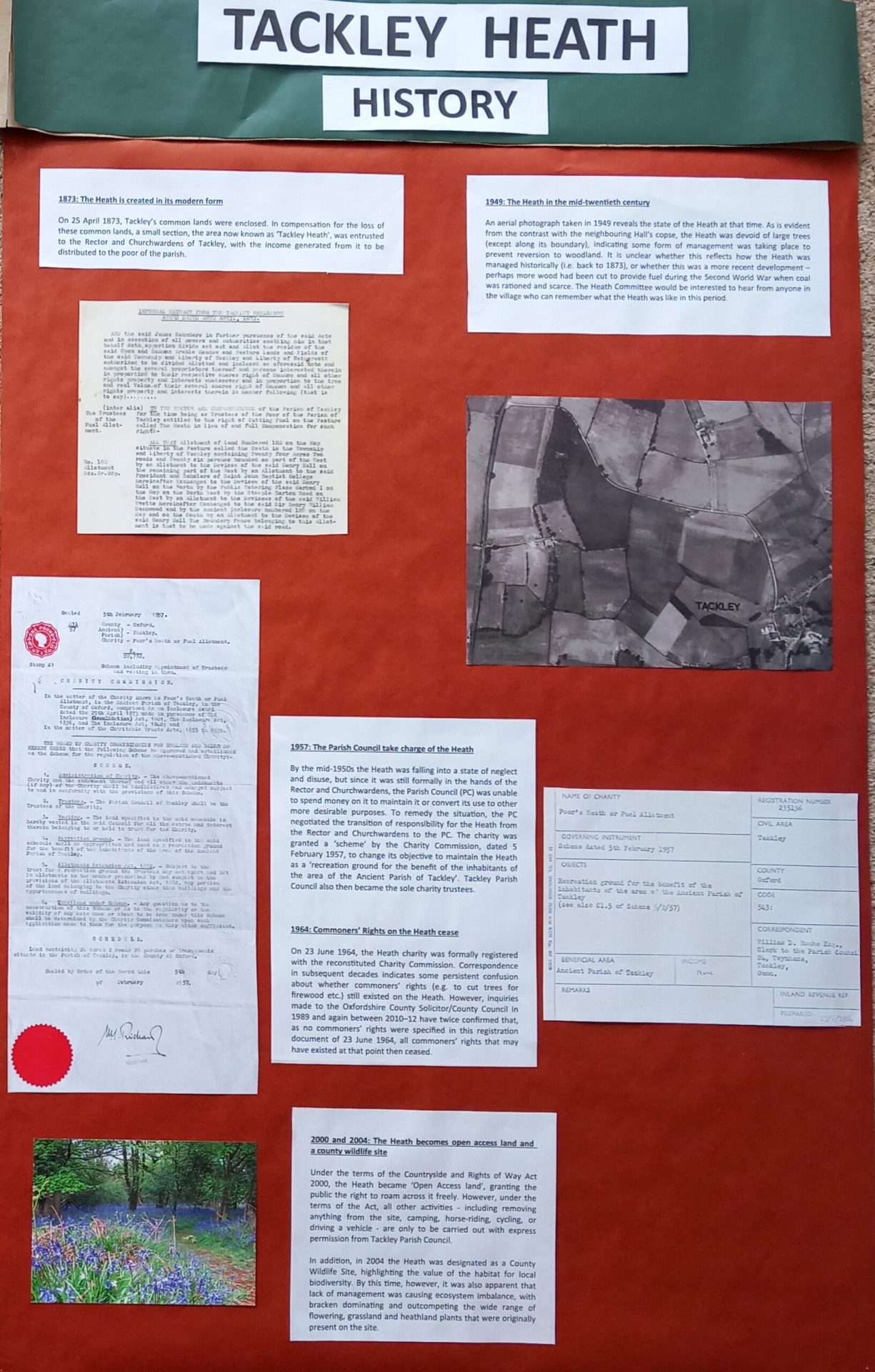
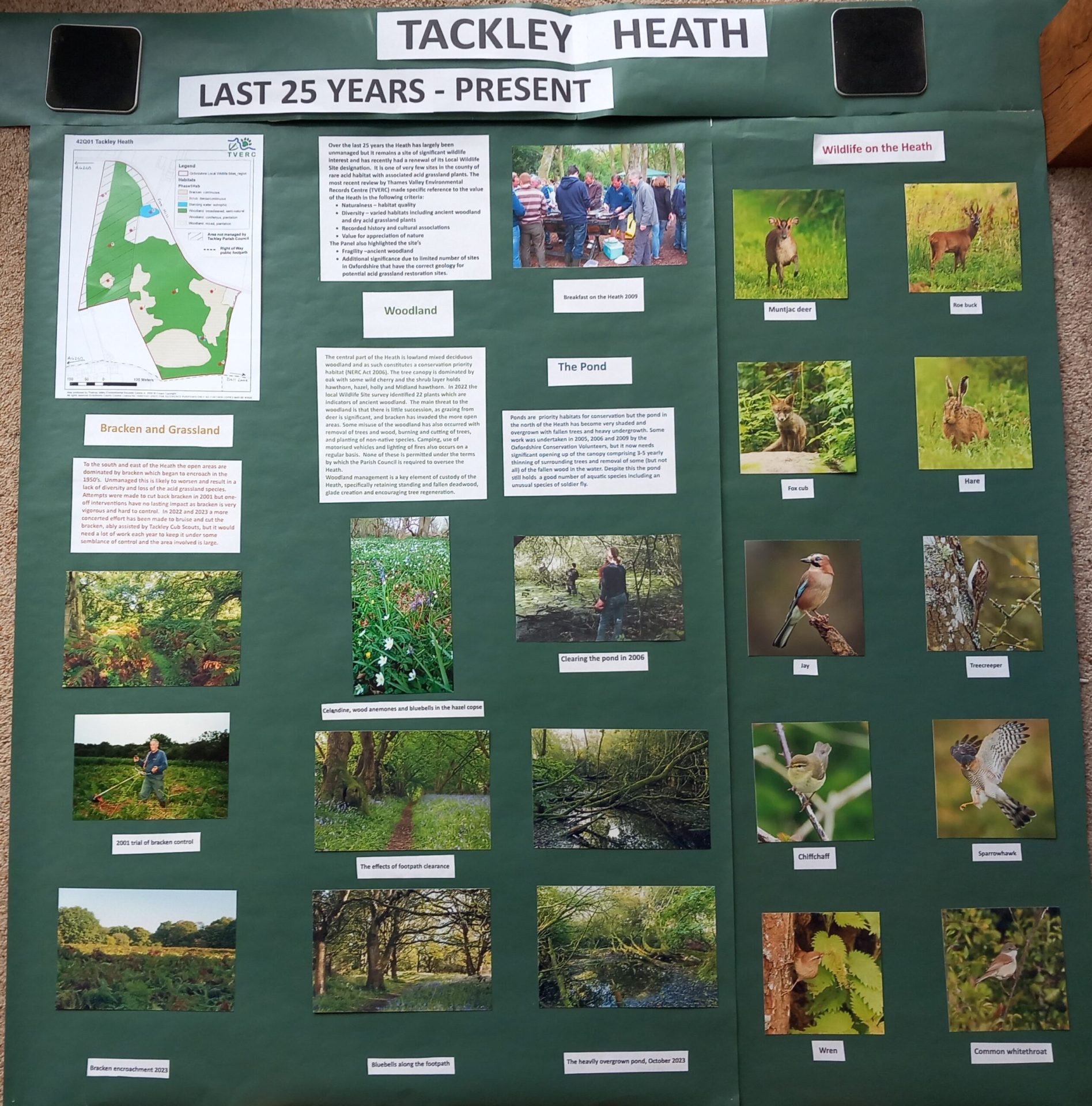
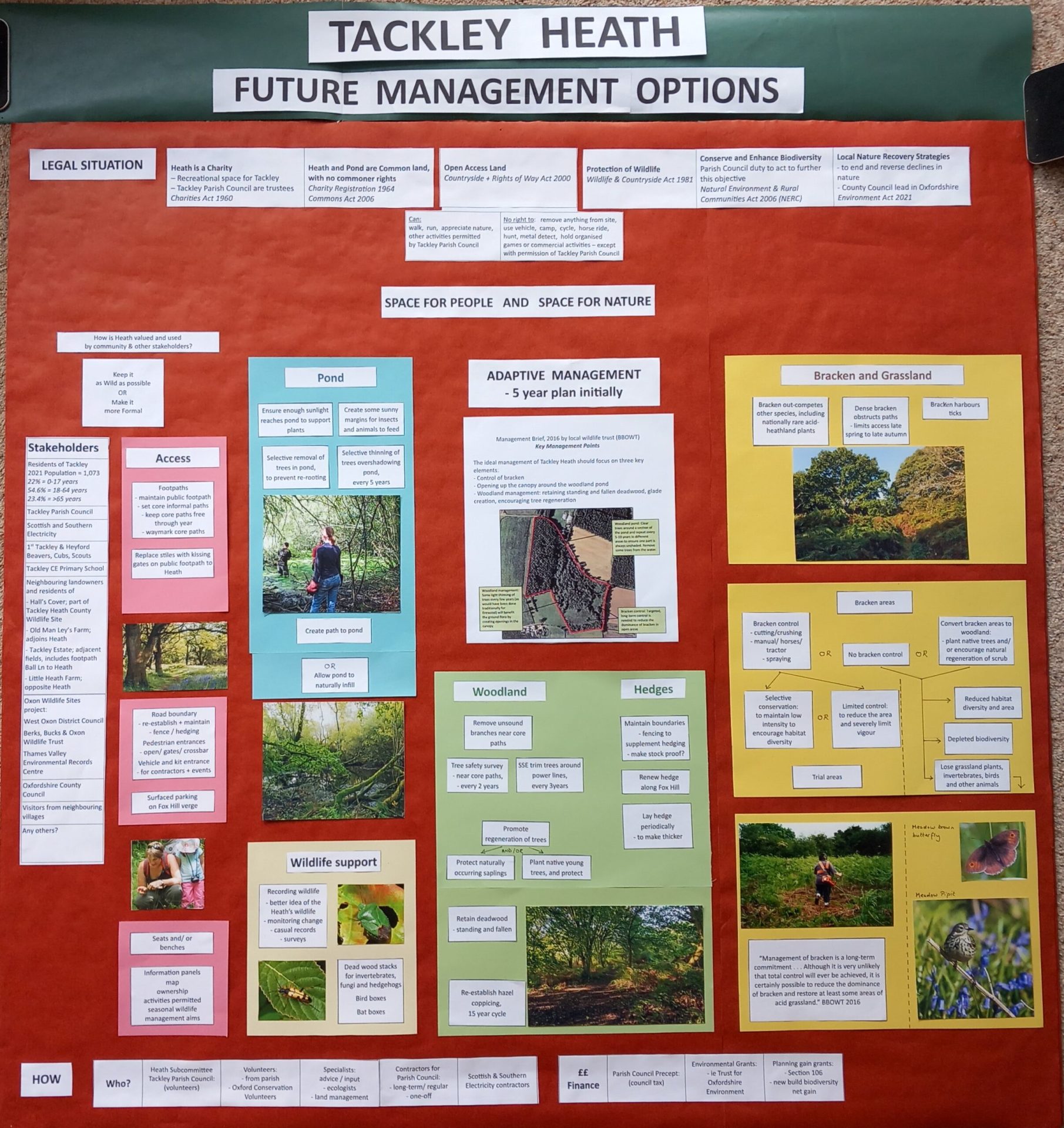
If you missed the consultation evening on 13th October you can view photographs of the posters that were on display by clicking the links below:
- Heath history poster
- Heath current poster
- Heath future management options
On 20th October 2023, a village questionnaire was completed regarding the future management of the Heath. The results can be viewed here. We always welcome any ideas, views or opinions on the management of the Heath so if you missed the questionnaire please do email us at naturespaces@tackleyvillage.co.uk. We are particularly keen to hear from anyone under 45 years old as this group were underrepresented in the responses to the questionnaire.
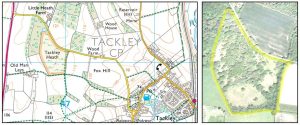
Tackley Heath is 10 hectares of common land, found to the northwest of the village, for residents and local people to enjoy. The Heath lies on an unusual area of acidic Oxford clay surrounded by a more alkaline limestone environment and is a rare habitat that is of national and international importance.
Tackley Heath Location and Aerial View
History
At the enclosure award of 1873 Tackley Heath became a ‘Poor’s heath or fuel allotment’, with the Rector and church wardens as trustees. It was in 1957 that the Parish Council became trustees of the Heath and its charitable objective changed to ‘recreation ground for the benefit of the inhabitants of the ancient parish of Tackley’. When Tackley Heath was registered as a charity in 1965 no commoner rights were specified – so any prior parishioner commoner rights then ceased, including cutting and collecting firewood. In 2004 Tackley Heath was designated one of Oxfordshire’s ‘County Wildlife Sites’ (also known as ‘Local Wildlife Sites’) due to its rare habitats (no 42Q01). Included in the County Wildlife Site is the adjacent, privately owned, Hall’s Cover to the west of the area. The area of the Heath managed by the Parish Council became ‘open access land’ under the Countryside and Rights of Way Act 2000.
iRecord – How you can get involved
iRecord is a national database where wildlife records can be uploaded and made available to others. Importantly for the village, the records can be used as evidence to support the Heath’s status as one of Oxfordshire’s Local Wildlife Sites. Alan Diver has now launched a page on the iRecords website, specifically for Tackley Heath – click here to go to the page.
Alan has also written a useful guide on how to use iRecord. Please do get involved. It would be very valuable for anyone who has a particular field of expertise to use their knowledge to expand and improve the data on the site, but don’t feel that you need to be an expert to use the page, it is still valuable, over time, to record simple things like when bluebells first flower or leaf buds break on Oak trees. We can already see evidence of climate change affecting local wildlife. For example, 10 years ago Blackcaps only visited in the summer to nest. Now there is a resident population, and we see them all winter in Tackley.
Nature Spaces Committee
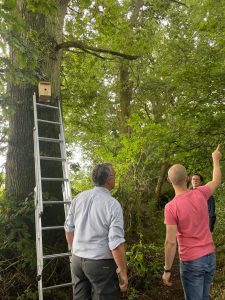
Over recent times, following the end of the use of the heath for firewood, coppicing and grazing, bracken has taken over, smothering the heathland species.
The Heath is now in need of management, and with growing local interest in doing more, the Parish Council formed a Heath sub-committee in 2022 and in Sept 2023 the remit of the sub-committee was extended to include all nature spaces in Tackley and the name of the committee was changed to the Nature Spaces Committee.
The committee’s initial practical focus has been keeping selected ‘core’ paths clear of brambles and bracken. This has been done by volunteers from the village at work-parties – held at weekends and summer evenings. Small scale trial bracken clearance, to encourage heathland plants, has been started. Around 26 Cub Scouts have repeatedly removed/bruised bracken in a designated patch, and will be continuing this, with their leaders. Strips alongside some core paths are also being kept clear of bracken. Minutes of the committee meetings can be found in the table at the bottom of this page.
Flora and Fauna
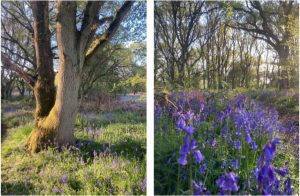
Tackley Heath is a mix of broadleaved woodland, scrub and extensive areas of bracken, with a woodland pond to the north providing additional interest. ln the past, remnant patches of acid grassland were found along the paths, where the shading effect of dense bracken is reduced. Lowland mixed woodland, dry acid grassland and heathland are all priority habitats for conservation in the UK. In 2022, Oxfordshire Wildlife Sites conducted a 10 yearly survey of the Heath. They recorded twenty-two woodland indicator plant species such as bluebell, early dog violet, bush vetch, three-nerved sandwort, primrose and wood anemone. Five plants typical of acid grassland were also recorded– wood sorrel, pill sedge, gorse, foxglove and common dog-violet. Formal records include about 80 other flora, including wood false-brome, dog’s mercury, ash, greater stitchwort, field maple, wild crab apple, holly, raspberry, giant fescue, wood sedge and wood mead.
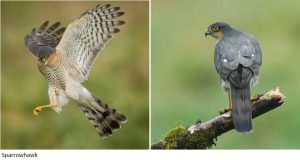
The woodland pond is heavily shaded by dense grey willow with many trees lying in the water. Some tree thinning has been carried out in the past by the Oxford Conservation Volunteers, but this is now overgrown. In the centre of the pond is a very unusual floating mat of plants. In 2006, 19 common aquatic species were recorded (including freshwater shrimp, newts, caddis fly, water beetles, leeches, and water snails) but also recorded was a rare species of Soldier Fly. On the edge of the pond, dragonflies and damselfly, such as the southern hawker and the large red, were recorded and butterflies including the large skipper, gatekeeper, ringlet, meadow brown, red admiral as well as the uncommon white admiral. Water forget-me-not, gypsywort, water plantain, cuckoo flower, celery-leaved water crowfoot, compact rush, and soft rush have been found. Rare bladder sedge, enchanter’s nightshade, water figwort, brooklime, hogweed, bugle and a variety of ferns were found around the pond. When most of us think of birds’ nests, we think of nests in trees but in open areas, like Tackley Heath, birds will lay their eggs and raise their chicks on the ground, making them more vulnerable to disturbance. It is estimated that about 70% of heathland in the UK has been lost over the last 100 years and as a result the birds that depend on this habitat have become increasingly rare. The true ground nesting birds you can find on the heath are pheasant and red legged partridge but many others nest either on the ground or in undergrowth a few inches off the ground. There are lots of chiffchaffs, whitethroats, wrens, and willow warblers on the Heath. Other residents are buzzards, red kites, kestrels, stock doves, wood pigeons, tawny owls, green and greater spotted woodpeckers, tits, nuthatches, treecreepers, robins, dunnocks, wagtails, finches, yellow hammers and house sparrows.
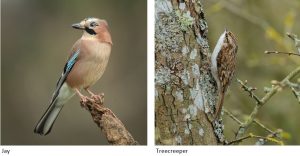
Migrant birds include hobbies, blackcap, cuckoos, swifts, swallows and the occasional stonechat. In the autumn and winter, fieldfares, redwings, siskins, redpolls, bramblings and the occasional goldcrest are seen.
Of the 6 species of deer found in the UK, 3 can be seen on the Heath – Muntjac, Roe and Fallow. Muntjac were introduced or escaped from private collections around 1900 and can be found throughout mainland Britain, including many cities. Unlike Roe and Fallow deer, they breed throughout the year and in recent years there have been several fawns up on the Heath. Roe deer are common in Tackley and you often see them in the fields bordering the Heath. Fallow deer were introduced in Norman times and there are several small herds around Tackley including some leucistic or white individuals. Grey squirrels, moles, badgers, foxes have also been spotted.
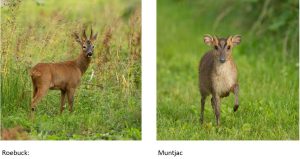
Photographs: August 2023, John Reynolds & Katherine Woodrow
Bat Survey
In 2022, a bat survey was conducted and three species were sighted – the Noctule, Common and Soprano Pipistrelle.
Moths
black arches moth photo by alan diver
This year Alan Diver has started deploying a moth trap on The Heath, both to record what appears there and to compare this with sightings from Chaundy Road, Tackley.
Some differences have already been noted. The Green Oak Tortrix moth, infrequently seen in the village, appeared one night in June on the Heath in numbers exceeding 100. The Acorn Weevil appeared in the trap. This has not been seen in Chaundy Road. Both examples, as their names imply, rely on the oak trees seen on the Heath. The moth’s caterpillar will, on occasion, feed on other broad-leafed trees but the weevil larvae cannot exist without acorns.
Over the same timescale, the beautiful Black Arches moth (photo left), recorded on the Heath, was only seen as a migrant at a few locations on the South Coast. It has been steadily marching north and, although not common nationally, is now resident, on our Heath.